Load Balancing
Purpose
- provide a unified view of the entire backend system to the end user
because the end user doesn't are which exact server handles their request - distribute the load (requests/data) equally across the other app/db servers
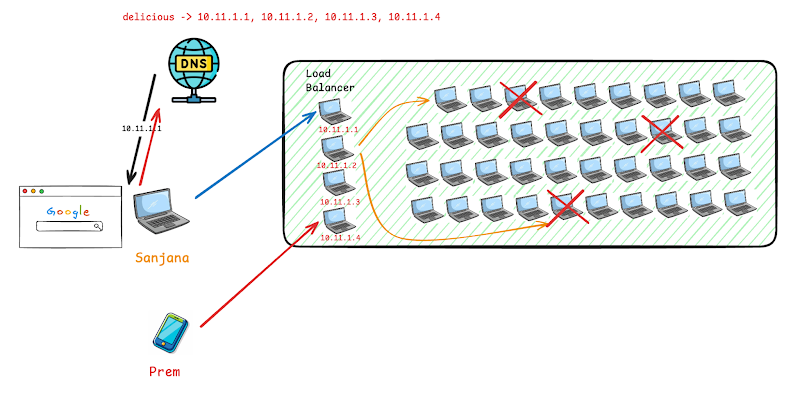
- How to configure: https://docs.google.com/document/d/1DxQzLpu1XPe_mRWsewNWtKL6E4uwKHQhBp7GX6Sg7qI/edit#heading=h.fzwcs020kou5
- Tutorial: https://avinetworks.com/what-is-load-balancing/
- Elastic Load Balancer (ELB - AWS): https://aws.amazon.com/elasticloadbalancing/getting-started/
142.250.192.4
IPv4: 0-255 . 0-255 . 0-255 . 0-255
total number of possibilities: 2^8 * 2^8 * 2^8 * 2^8 = 2^32 ~ 4 billion
number of devices on the internet: 100 billion - 1 trillion
Static vs Dynamic IPs
IPv6: 128 bits
Number of possibilities: 2^128 ~ 256 billion billion billion billion
Q: Which server should a particular request be sent to?
To understand this, we first must understand how the data is distributed across the various servers.
Because otherwise, we will end up sending the requests to servers which don't contain the appropriate data (Sanjana's request get sent to a server which contains Ashok's data)
How to store the data?
Q: Can we store all the data on 1 server?
No. We got multiple laptops because we were running out of resources (disk space / CPU / ..)
Q: Should we split the data randomly?
How will we retrieve it?
The data storage has to follow some logic - that can be repeated.
We should be able to find out at any time, which data is stored in which server.
Data Sharding
.png)
Vertical Partitioning (Normalization)
why? Because you want to normalize it
.png)
Horizontal Partitioning
why?
- improve indexing performance
- support multi-tenancy (prevent data cross-communication between clients)
.png)
Vertical Partitioning (across servers)
why?
Migrate to microservice / separation of concerns
.png)
Horizontal Partitioning (across servers)
why?
All the data cannot fit on a single server
.png)
Sharding
Sharding is simply "Horizontal Partitioning across servers"
Sharding Key - sharding is always based on some value - sharding key
How to choose a good sharding key - we will see this in a later lecture
Sharding <=> Routing
It should not be the case that sharding following logic A, but routing follows logic B.
Why?
Because if that is the case - then the requests will end up on servers that don't contain the necessary data!
The logic / algorithm must be the same for both sharding & routing
Therefore, all we have to do is use a Routing Algorithm.
Sharding happens via Routing
Routing is the thing that happens - sharding is just a side effect of routing!
If we're routing based on user-id, then automatically the sharding will happen based on user-id
Because if Sanjana's requests are being routed to server A, then only server A will be able to the store Sanjana's data (because server B / C never received requests with Sanjana's data in the first place!)
We only decide (which request -> which server)
The moment we decide (which request -> which server),
we've also automatically decided (which data -> which server)
Routing Algorithms
Routing algorithm runs inside the Load Balancers.
It is how the LB decides which request goes to which server
How "Good" is your routing?
What characteristics should a good routing algorithm have?
- Fast - computationally easy to decide which request goes to which server
- Equal distribution - should divide the load (data & requests) equally across all servers
- We should be able to freely add/remove servers
- servers are unreliable, so they can crash, so the number of servers can decrease
- we might need to scale out more, so we might add more servers, so the number of servers will increase
- Minimal data movement - When the number of servers change, the data movement must be minimal
- Routing should be deterministic without exchanging information
- we've multiple load balancers
- all the load balancers should always be "in-sync" - they should forward the same type of requests (say Sanjana's requests) to the same server because otherwise, Sanjana's data will be all over the place
- They must not have to constantly communicate with each other to be "in-sync" - because constant communication for every request will be too much of an overhead
Round Robin
Send the next request to the next server.
Simple % based technique
server_list = ["10.11.6.12", "10.11.5.17", ...]
fn handle_request(request):
key = request.user_id
N = len(server_list)
server_id = key % N
server = server_list[server_id]
forward_request(request, server)
server_list = [A, B, C, D]
user_id = 0 .... 100
Initial Distribution
A 0 4 8 ...
B 1 5 9 ...
C 2 6 10 ...
D 3 7 11 ...
n = 4
Adding / Removing servers
let's say server B crashes.
A 0 3 6 9 ...
B
C 1 4 7 10 ...
D 2 5 8 11 ...
Since server B has crashed, and users (1, 5, 9, ..) were previously on server B, of course, their data has to be migrated (how? Son Pari)
However, other users' data should not have to be migrated needlessly because their servers are still working - there's no need to move their data!
Is that the case?
No! Pretty all the data gets shuffles around.
Similarly, when we add servers, once again, the value of N will change. The value of (user_id % N) will also change for pretty much everyone.
Pros
Fast, Equal Distribution, No need of syncing information
Cons
Lots of unnecessary data movement!
Bucketting
Assign the server -> user_id in ranges
A will get user_ids 0 ... 99
B will get user_ids 100 ... 199
C will get user_ids 200 ... 299
D will get user_ids 300 ... 399
total users = 400
Adding / Removing servers
if Server B crashes
A will get user_ids 0 ... 132
C will get user_ids 133 ... 265
D will get user_ids 266 ... 399
More users sign up
We cannot accommodate new users in existing servers - because we have already decided the buckets.
So it is impossible to add new users without first buying more servers
Pros
Equal data distribution
Fast
Cons
Too much data re-shuffling
Cannot even add users
Mapping Table
What if the LB maintains a Hashmap from user_id to server_id?
server_list = ["10.11.6.12", "10.11.5.17", ...]
mapping = {
sanjana: A
prem: B
bathula: A
pallavi: C
venkat: B
...
}
fn handle_request(request):
key = request.user_name
server = mapping[key]
forward_request(request, server)
Adding / Removing servers / users
Let's suppose server B crashes
fn handle_server_crash(crashed_server):
for user, server in mapping:
if server == crashed_server:
// assign a new server to this user
new_server = get_random_server()
mapping[user] = new_server
son_pari_please_migrate(user, crashed_server, new_server)
fn handle_new_user(user):
server = get_random_server()
mapping[user] = server
If we do this, will the data of people that were earlier on the crashed server get moved? Yes (that is desired)
For the users whose servers are still running, will their data get moved? No.
Pros
Equal data distribution, Fast, minimizes data movement
Cons
We will have to keep this mapping table in sync for all the LBs.
If different LBs have a different mapping table, then the requests will end up in random servers!
Keeping data in sync, always, with very low latency => extremely hard problem
IMPOSSIBLE !
Consistent Hashing
Pros
All of the above!
- Fast
- equal load distribution
- freely add/remove servers
- minimal data movement
- no need for any sync between LBs
Cons
None!
break from 8.50 am - 9.00 am
Hash Function
fn add(a, b):
return a + b
Function is a "deterministic" mapping from inputs to outputs.
add(2, 3) => 5
add(2, 3) => 5
add(2, 3) => 5
no matter how many times I call a function, it will always give me the same result for the same input
state = 0
fn proc add(a, b):
state = b
return a + b + state
in this case, the function procedure (impute function) doesn't always return the same value - because it has side effects
Hash function is a "digest" function. Function that takes as input anything, but returns values within a fixed range.
fn hash_1(data):
return (sum of ascii values of chars of data) % 100
fn hash_2(data):
return (sum of squares ascii values of chars of data) % 799
fn hash_3(data):
return (multiply even and odd numbers in the data) % 1337
in this case, no matter what the data, the output will always be from 0 .. 99
- Definitions and properties: https://en.wikipedia.org/wiki/Hash_function
- Cryptographically secure (extra guarantees): https://en.wikipedia.org/wiki/Cryptographic_hash_function
- Family of hashes: https://en.wikipedia.org/wiki/Universal_hashing
Hash Ring - output space of a given hash function
.png)
Placing Users & Servers on the Hash Ring
- Consider 1 hash function hash_0 for hashing the users
.png)
- Consider k hash functions hash_1 ... hash_k for hashing the servers
typical value of k is 32 or 64
.png)
These hash functions are set-up while the LB is being coded/configured.
All the LBs for a system will have the same set of hash functions in their code.
All these (k+1) hash functions have the same output space (say 0 ... 2^64 - 1)
https://en.wikipedia.org/wiki/K-independent_hashing
suppose our hash function outputs values in the range 0.. (2^64 - 1)
Given 1 billion users, and 1 million servers, what is the probability that two hashes collide?
This probability will be very close to 0.
Consistent Hashing Algorithm
- For each server that we have, we will hash it using all the hash functions hash_1 .. hash_k and put the server on the ring..
- Whenever a request arrives, we will hash the user_id using the hash_0 and place the user on the ring
- The request will be forwarded to the first server on the ring which is in the clockwise direction
.png)
import bisect
def custom_hash(data, i):
h = sum(ord(c) ** i | 0xaff for c in data)
h *= 3
h >>= 1
return h % 10
def build_ring(servers, k):
ring = []
for server in servers:
for i in range(1, k+1): # 1..k
h = custom_hash(server, i)
print(f'adding {server} to spot {h}')
ring.append((h, server))
ring = sorted(ring)
print('final ring:', ring)
return ring
def route(user):
user_hash = custom_hash(user, 0)
# I now need to find the 1st server in the ring
# that is to the right of the user
index = bisect.bisect_right(ring, (user_hash, user))
index = index % len(ring) # wrap it around the ring
server_hash, server = ring[index]
print(f'{user} hashed to {user_hash}. Routing them to {server} at location {server_hash}')
return server
servers = [
'10.11.1.13',
'10.11.2.17',
'10.11.13.167',
'10.11.12.255',
'10.11.1.0',
]
ring = build_ring(servers, 3)
route('Vishal')
route('Vishal')
route('Sanjana')
route('Vishal')
route('Sanjana')
route('Sanjana')
Is the algo deterministic? will Sanjana always go to server C (as long as Sanjana is alive, and server C is running, and not servers are added/removed)?
Yes!
Is the algo fast?
Yes! The ring is a sorted array, and to find the nearest server in the clockwise direction, you have to do a binary search (upperbound) for the user's hash.
O(log (Nk)) where N is the number of servers, and k is the number of server hashes
https://arpitbhayani.me/blogs/consistent-hashing/
Do the LBs have to share any data to be in sync?
No!
- Each LB knows which servers are running (via health-check/heartbeat)
- The code in each LB is the exact same
- So, each LB will calculate the same hashes and the same ring
- So, each LB will calculate the same server for any user
Is the data distribution even?